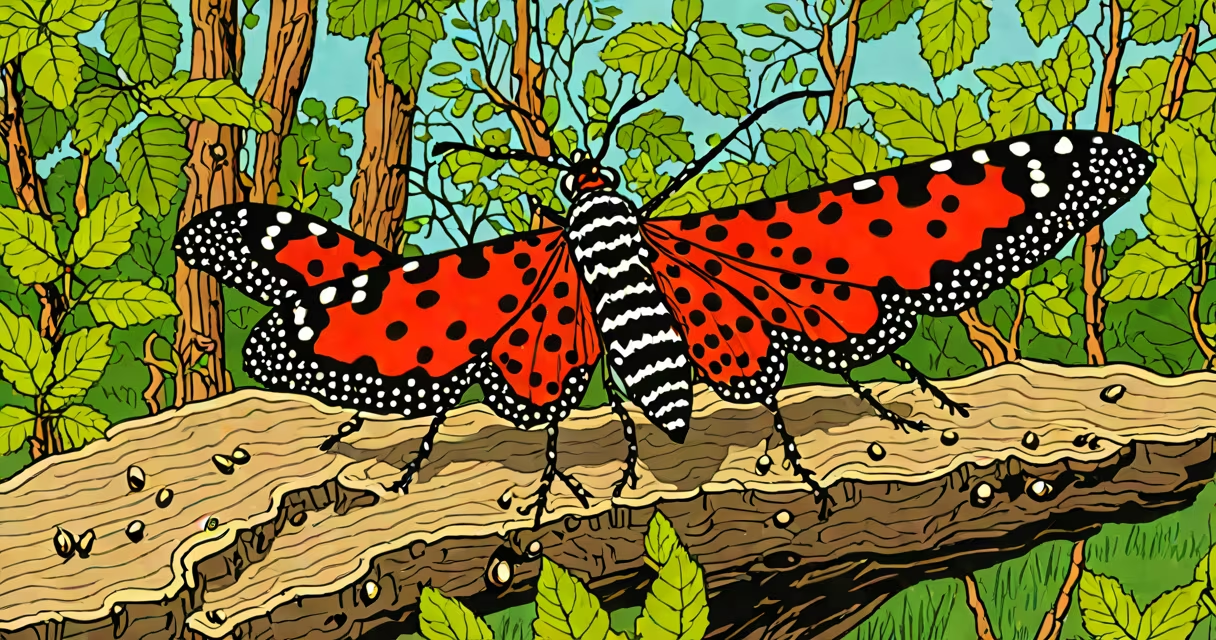
The spotted lanternfly (Lycorma delicatula) is an invasive insect native to parts of Asia that causes severe damage to agricultural crops, ornamental trees, and forest ecosystems. Eradicating it prevents economic losses, protects biodiversity, and preserves native plant health.
First identified in the United States in 2014 in Pennsylvania, the spotted lanternfly feeds on sap from over 70 plant species, including grapevines, fruit trees, and hardwoods. Its feeding weakens plants, reduces yields, and promotes the growth of sooty mold, which further harms photosynthesis. The insect's life cycle includes egg masses laid in late fall, nymphs emerging in spring, and adults active from June through October.
Infestations have since spread to at least 16 U.S. states, with New York, New Jersey, and Maryland reporting high population densities. The U.S. Department of Agriculture (USDA) classifies the spotted lanternfly as a quarantine pest, meaning movement of materials from infested areas is restricted to prevent further spread.
Lanternflies pierce plant tissue with their needle-like mouthparts and suck out sap. This process disrupts nutrient flow and depletes energy reserves. A single adult can consume up to 10 times its body weight in sap daily. Over time, this leads to stunted growth, leaf curling, and branch dieback.
When feeding, lanternflies excrete a sugary substance called honeydew. This attracts ants, wasps, and fungi. Sooty mold grows on honeydew deposits, covering leaves and blocking sunlight. In vineyards, this reduces grape quality and increases the risk of fungal infections. A 2022 study by Penn State Extension estimated that uncontrolled lanternfly populations could cost the Pennsylvania wine industry $12 million annually in lost revenue.
Hardwood forests are also at risk. Species like black walnut and maple suffer reduced growth and increased mortality. In 2023, researchers documented a 40% decline in sapling survival rates in areas with high lanternfly density. Native pollinators, such as bees and butterflies, face indirect harm due to disrupted plant health and habitat degradation.
Control strategies fall into four categories: physical removal, chemical treatment, biological control, and public awareness campaigns. Each has trade-offs in speed, cost, and environmental impact.
| Method | Effectiveness | Time to见效 | Environmental Risk |
|---|---|---|---|
| Scraping egg masses | High (prevents new nymphs) | Immediate (if done early) | None |
| Trunk banding with sticky traps | Medium (catches nymphs) | 2-4 weeks | Low (non-target insects may be caught) |
| Systemic insecticides (e.g., imidacloprid) | High (kills adults and nymphs) | 1-3 weeks | Medium (can affect pollinators and soil microbes) |
| Biological agents (e.g., parasitic wasps) | Low to moderate (still under research) | 6+ months | Low (target-specific) |
Physical removal remains the most sustainable method. Homeowners are advised to scrape egg masses off trees and seal them in alcohol or tape. Sticky bands around tree trunks capture nymphs during their upward migration. These methods are safe, low-cost, and effective when applied consistently.
Chemical treatments are reserved for large-scale infestations. The USDA recommends using systemic insecticides only in licensed applications. Overuse risks harming beneficial insects and contaminating waterways. A 2021 EPA report noted that improper application led to detectable levels of imidacloprid in nearby streams near treated orchards.
Many assume lanternflies are harmless because they don't bite humans or carry diseases. This is incorrect. While they do not transmit pathogens to people, their ecological impact is severe. They are not native to North America and lack natural predators here, allowing unchecked population growth.
Another myth is that lanternflies only affect fruit trees. In reality, they attack hardwoods, ornamental shrubs, and even utility poles. A 2023 survey by the University of Delaware found that 63% of reported infestations occurred on non-crop trees, including maples and elms.
Some believe eradication efforts are unnecessary because the insects "won't survive winter." This is false. Adult lanternflies die in cold weather, but their eggs survive freezing temperatures. Eggs laid in late autumn remain viable until spring hatch. One egg mass can contain 30-50 eggs. Without intervention, a single female can produce multiple generations in a year.
In 2018, Pennsylvania launched a statewide lanternfly suppression program. The state deployed over 1,200 trained inspectors and distributed 500,000 sticky bands to residents. By 2022, the program had reduced nymph emergence by 68% in targeted zones.
A vineyard owner in Berks County reported a 55% increase in grape yield after implementing egg scraping and banding. He also observed a return of native bees to his property within two seasons. "Before, our vines were covered in honeydew," he said. "Now, the leaves are clean, and the fruit tastes better."
These results align with data from the USDA's Animal and Plant Health Inspection Service (APHIS), which confirms that coordinated local action slows spread. Areas with consistent community participation saw 70% fewer new infestations compared to unengaged regions.
Some argue that killing any living creature is ethically problematic. However, the spotted lanternfly is not a native species. It has no role in local food webs and disrupts established ecological relationships. Its presence threatens hundreds of native species that depend on healthy forests and farmland.
Ecologists emphasize that conservation priorities focus on protecting ecosystems, not individual organisms. The spotted lanternfly's invasion parallels other known threats, such as the emerald ash borer and Asian longhorned beetle. All have caused irreversible damage when left unchecked.
As a resident of New Jersey, I once observed a mature oak tree die within 18 months of lanternfly infestation. The bark split open, revealing tunnels filled with larvae. The tree fell during a storm, damaging a neighbor's garage. That event reinforced the urgency of early intervention.
Preventing the spread of invasive species is not about cruelty-it's about preserving shared resources. The U.S. Fish and Wildlife Service states that invasive species are responsible for 42% of endangered species listings. Eliminating pests like the spotted lanternfly helps maintain biodiversity and ensures long-term food security.
Understanding why we should kill lanternflies is not about eliminating life, but about protecting complex systems that support human and ecological well-being. Immediate action reduces future costs, safeguards livelihoods, and maintains the integrity of natural landscapes.