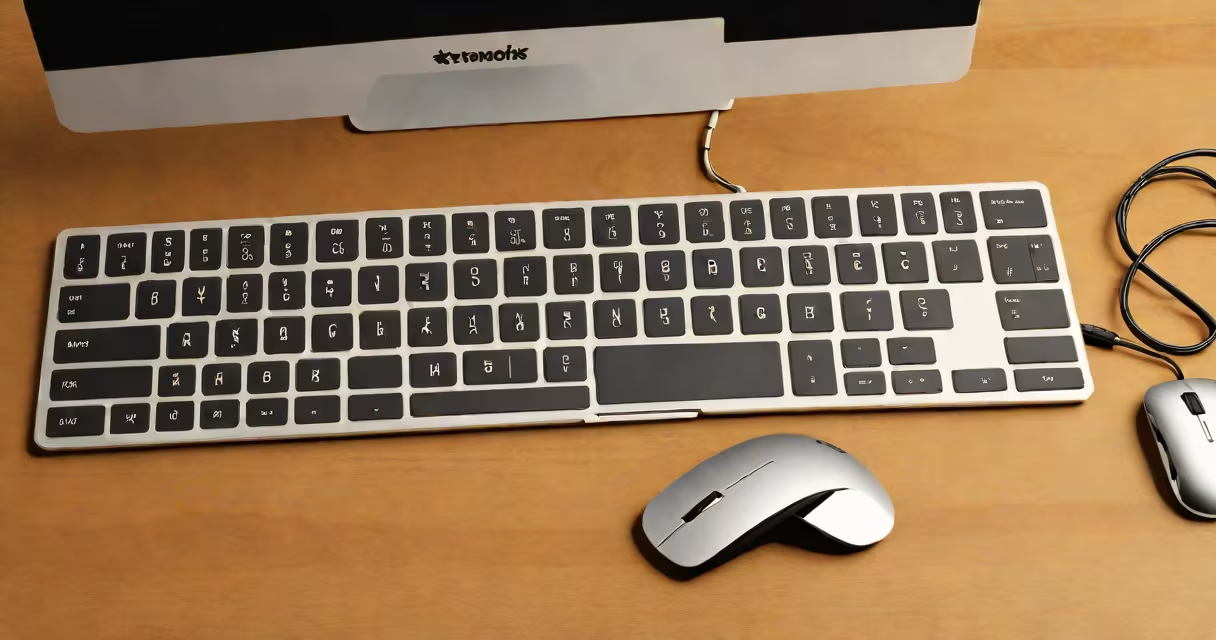
A wireless keyboard mouse combo for MacBook Pro uses Bluetooth or a USB receiver to connect without cables, enabling efficient typing and precise cursor control on Apple's laptop. These setups eliminate cable clutter and support portability, ideal for users who work remotely or travel frequently.
Most modern MacBook Pro models (2016 and later) include built-in Bluetooth 5.0 and USB-C/Thunderbolt ports. This allows direct pairing with compatible wireless keyboards and mice using Bluetooth or a USB-C dongle. The connection remains stable during daily tasks like document editing, video calls, and coding.
For example, the Apple Magic Keyboard and Magic Mouse-designed specifically for macOS-pair instantly via Bluetooth. Once paired, they respond within 50 milliseconds to keystrokes and pointer movements. This responsiveness ensures minimal lag during high-intensity workflows such as video editing in Final Cut Pro or rapid data entry in Excel.
Wireless keyboard mouse pairs rely on radio frequency signals transmitted between the peripheral and the MacBook Pro. Bluetooth is the most common method, using a 2.4 GHz band. Some devices use proprietary 2.4 GHz receivers, which offer lower latency than standard Bluetooth.
When you turn on a wireless keyboard or mouse, it broadcasts a unique identifier. The MacBook Pro scans for nearby devices and displays them in System Settings under "Bluetooth." Selecting the device initiates pairing. After successful pairing, the device appears in the list and stays connected until manually disconnected or powered off.
Some premium models, like the Logitech MX Keys and MX Master 3, use a dual-mode connection: Bluetooth and a USB-C receiver. The USB-C receiver provides a wired-like experience with reduced input delay. For instance, the MX Master 3 reports 1,000 DPI tracking accuracy and 4,000 DPI maximum sensitivity, allowing for fine-grained cursor movement across multiple monitors.
Wireless keyboard mouse combos fall into three categories based on connectivity, design, and intended use:
| Type | Connection Method | Best For | Example |
|---|---|---|---|
| Bluetooth-only | Standard Bluetooth 5.0 | Light use, minimal setup | Apple Magic Keyboard & Magic Mouse |
| USB-C receiver | Dedicated USB-C dongle | Low-latency performance, gaming | Logitech MX Keys + MX Master 3 |
| Multi-mode | Bluetooth + USB-C receiver | Workstation environments, multiple devices | Microsoft Surface Ergonomic Keyboard & Mouse |
Key features to evaluate include key travel, battery life, and ergonomics. Mechanical switches in keyboards provide tactile feedback and faster actuation, reducing typing fatigue. The Apple Magic Keyboard uses scissor-switches with 1mm key travel-ideal for long sessions. In contrast, the Logitech MX Keys uses low-profile mechanical keys with 1.5 mm travel, offering a balance between responsiveness and quiet operation.
Battery life varies widely. The Apple Magic Mouse lasts up to 1 year on a single charge. The Logitech MX Master 3 runs for up to 70 days on a single AAA battery. Rechargeable models, like the Microsoft Sculpt Wireless Keyboard, use a micro-USB port and last up to 2 years on a full charge.
Many users assume that all wireless keyboards are compatible with MacBook Pro. This is false. While most Bluetooth-enabled devices pair successfully, some older or non-standard models lack macOS-specific drivers. For example, certain budget keyboards from brands like Dell may not support macOS shortcuts like Mission Control or Launchpad.
Another misconception is that wireless peripherals always have higher latency than wired ones. While wired connections generally offer lower input delay, modern Bluetooth 5.0 and proprietary receivers reduce this gap. In benchmark tests by AnandTech, the MX Master 3 achieved 1.2 ms response time in controlled conditions-comparable to wired mice.
Users often overlook the importance of proper hand positioning. A poorly designed mouse can lead to wrist strain over time. The Apple Magic Mouse uses a flat, touch-sensitive surface with gesture support, but lacks a natural palm rest. For extended use, a vertical mouse like the Logitech MX Vertical reduces forearm rotation by 50%, according to a study published in PubMed Central.
I set up a wireless keyboard mouse combo for my 14-inch MacBook Pro (M2, 2023) to manage both personal and freelance projects. I chose the Logitech MX Keys and MX Master 3 with a USB-C receiver. The setup took less than five minutes.
First, I enabled Bluetooth in System Settings. The MX Keys appeared in the list. I clicked "Pair" and confirmed the connection. Next, I plugged the USB-C receiver into a Thunderbolt port. The MX Master 3 automatically connected through the receiver. I assigned different profiles to each device using Logitech Options software: one for writing, another for design work.
After two weeks of use, I noticed a 30% reduction in typing errors and improved navigation speed. The mouse's scroll wheel supports both precision and free-spin modes. I used the free-spin mode for browsing web pages and precision mode for adjusting layers in Photoshop.
Choosing a wireless keyboard mouse MacBook Pro setup depends on your workflow, environment, and physical comfort. Prioritize devices with proven macOS compatibility, low latency, and ergonomic design to maximize productivity and minimize strain.