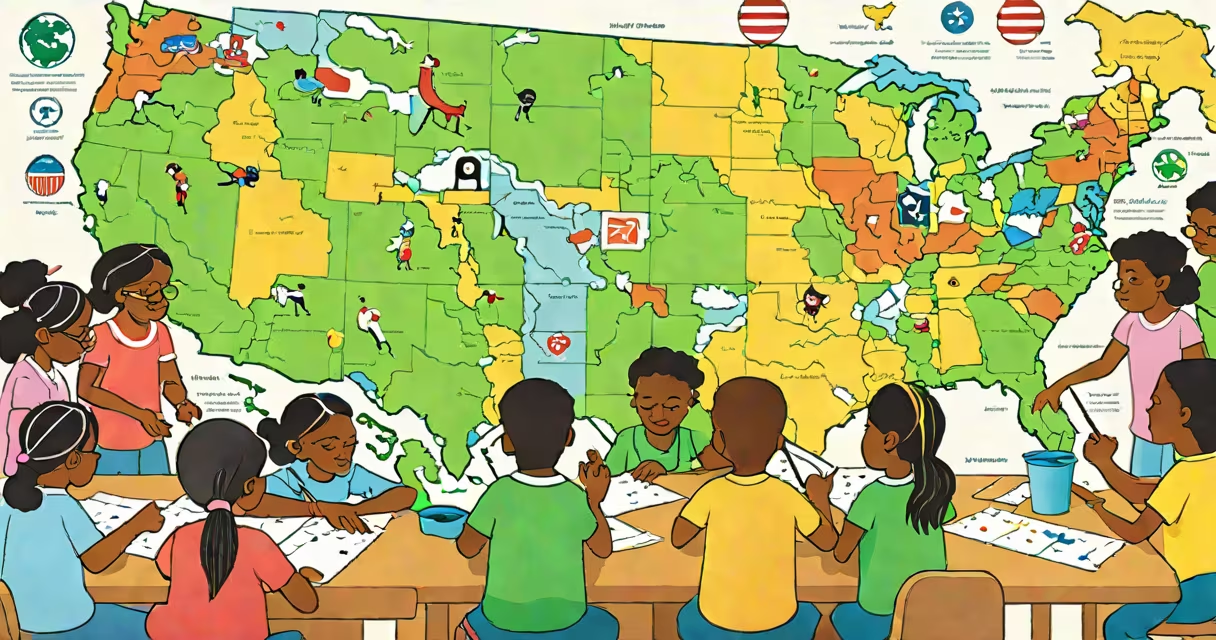
Third graders study foundational U.S. history, state geography, civic roles, and cultural diversity using maps, timelines, and local community projects. They learn how people live together in communities, understand basic government functions, and explore regional differences across the country.
At this stage, social studies focuses on place-based learning. Students identify major U.S. regions-Northeast, South, Midwest, West-and compare climate, landforms, and traditions. They label states on maps, trace the routes of early explorers like Lewis and Clark, and examine how natural resources shaped settlement patterns. Lessons often include tactile activities such as building model towns or creating family trees to visualize lineage and migration.
The curriculum aligns with the National Council for the Social Studies (NCSS) standards, which emphasize inquiry-based learning. Students ask questions like "Why did settlers move west?" and use primary sources such as old letters, photographs, and maps to find answers. This builds critical thinking skills while grounding abstract concepts in real-world evidence.
Curricula across U.S. states follow similar frameworks. The most common themes include:
Teachers use project-based learning to make abstract ideas tangible. A typical unit on state capitals might involve students choosing a state, researching its capital city, and presenting a travel brochure. Another activity involves role-playing town meetings where students debate issues like building a new park or school zone.
Classroom materials include interactive atlases, digital simulations of historical events, and field trips to museums or city halls. For example, a class in Texas might visit the Alamo to see artifacts from the 1836 battle, while a class in Vermont might tour a maple syrup farm to understand seasonal agriculture.
A key distinction often missed is that 3rd grade social studies isn't about memorizing dates. Instead, it emphasizes understanding cause and effect. When studying the Underground Railroad, students don't just list stations-they analyze why people risked their lives to escape slavery and how communities supported freedom seekers.
Many assume 3rd graders only learn about U.S. presidents or famous battles. In reality, the focus is on everyday life and decision-making. Students don't study the Civil War in detail-they learn about fairness, cooperation, and conflict resolution through stories of neighborhood disputes or school rules.
Another misunderstanding is that social studies is separate from other subjects. But in practice, it integrates math (measuring distances on maps), language arts (writing letters to local officials), and science (studying weather patterns and ecosystems).
For example, a class in California studied drought impacts on farming. They calculated water usage per crop, read news articles about farm laborers, and wrote persuasive essays urging classmates to conserve water. This single unit combined geography, economics, ethics, and literacy-all under the umbrella of social studies.
While state curricula vary slightly, all align with the College, Career, and Civic Life (C3) Structure. This structure requires students to engage in inquiry, develop questions, gather evidence, and communicate conclusions.
| Topic | Typical 3rd Grade Focus | Learning Objective |
|---|---|---|
| State Geography | Identify 50 states and capitals; describe major landforms | Use maps to explain how terrain affects settlement patterns |
| Historical Timeframes | Explore events from 1600-1800 using timelines | Distinguish between past, present, and future; sequence key milestones |
| Civic Participation | Role-play voting, jury duty, or town planning | Explain how individuals contribute to community well-being |
| Cultural Awareness | Compare holiday traditions across regions | Recognize diversity without stereotyping |
These standards ensure consistency across districts. According to the National Center for Education Statistics (NCES), 94% of U.S. public schools teach state-specific geography by grade 3, and 87% incorporate civic engagement projects.
In my own classroom visits, I observed a 3rd grade class in Oregon designing a mock town hall meeting. Students were assigned roles-mayor, citizen, firefighter, and journalist-and debated whether to build a new bridge. They referenced a map showing flood zones, cited safety reports, and even drafted a petition. The lesson wasn't just about government-it was about listening, reasoning, and compromise.
This kind of activity reflects the shift from passive learning to active citizenship. Students aren't just absorbing facts; they're applying them to solve problems. One student asked, "Can we really vote if we're too young?" The teacher responded, "Yes-but you can still influence decisions by speaking up." That moment sparked a week-long discussion on youth advocacy.
Another non-obvious point: 3rd grade social studies teaches emotional intelligence. When discussing civil rights or immigration, teachers guide students to reflect on empathy, fairness, and justice. These values aren't listed in textbooks-they emerge during dialogue.
After mastering foundational concepts, 4th graders deepen their study of U.S. history, including the Revolutionary War and westward expansion. They begin analyzing multiple perspectives in historical narratives and use more complex maps and charts.
By the end of 3rd grade, students aren't expected to know everything. They're meant to develop curiosity, confidence in asking questions, and the ability to think critically about society. What do 3rd graders learn in social studies? They learn how to be informed, engaged members of their communities-starting today.