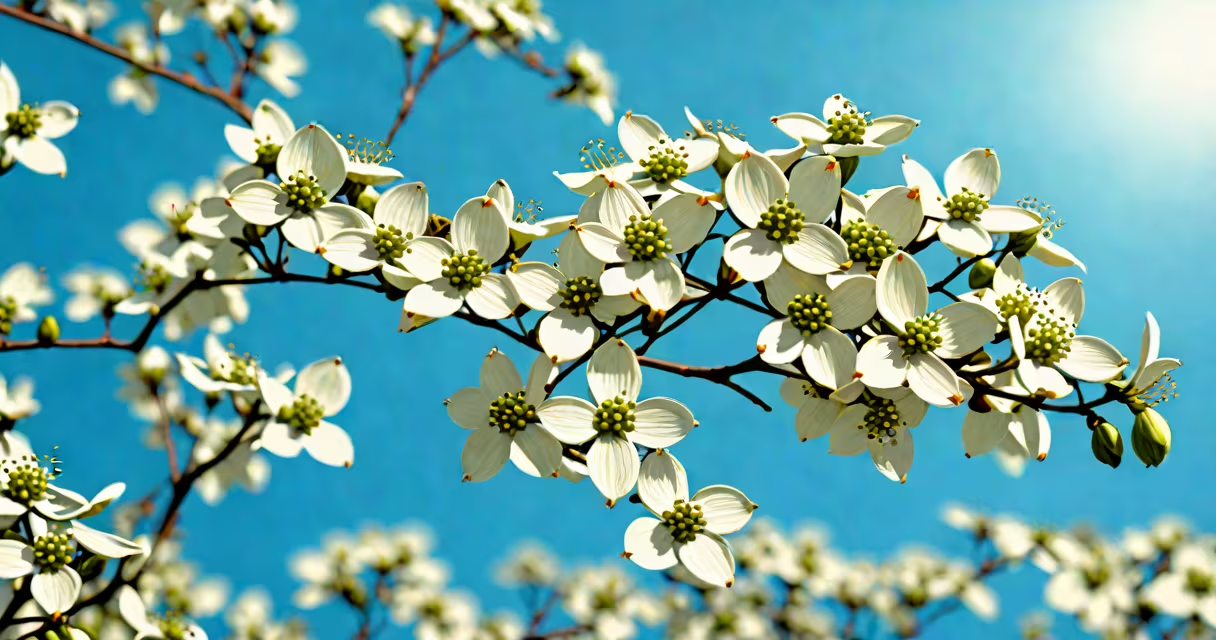
The dogwood tree symbolizes rebirth, resilience, and spiritual sacrifice. Its springtime blooms represent renewal, while its historical use in Christian tradition ties it to the crucifixion of Jesus. The tree also holds significance in Native American cultures, where it appears in stories about healing and protection.
Dogwood trees (Cornus florida) produce four-petaled flowers that resemble crosses. This visual resemblance led early European settlers in North America to associate the tree with Christian symbolism. According to the British Museum's collection notes on religious flora, the cross-shaped petals were interpreted as a sign of Christ's sacrifice, especially during Easter celebrations. The tree's bark was even used in folk medicine, reinforcing its role as both sacred and practical.
Spring is the season of dogwood bloom. In the eastern United States, the tree typically flowers between late April and early May. Its white or pink blossoms appear before leaves, signaling the start of warmer weather. This timing aligns with themes of resurrection and new beginnings. The National Park Service documents that dogwood flowering dates are tracked annually to monitor climate shifts, showing how deeply embedded the tree is in seasonal cycles.
| Symbolism Type | Meaning | Cultural Source |
|---|---|---|
| Christian | Crucifixion, resurrection, divine love | Colonial American churches, hymns |
| Nature & Seasonal | Rebirth, renewal, spring's arrival | Native American tribes, ecological calendars |
| Resilience | Endurance through harsh winters, recovery from damage | Forestry reports, urban landscaping records |
Native American tribes, particularly the Cherokee and Iroquois, viewed the dogwood as a protective plant. The Cherokee used its bark in remedies for fevers and digestive issues. According to the National Park Service's Indigenous Peoples resource, the tree was sometimes planted near homes to ward off illness and evil spirits. Its dense wood was also used to make tools and arrow shafts, adding to its reputation as a durable, life-sustaining species.
A common misconception is that the dogwood's name comes from "dog" because of its tough, unpalatable fruit. This is incorrect. The word "dogwood" derives from Old English "dōgge", meaning "to bite," referring to the tree's hard, sharp wood. The fruit, though bitter, is edible and has been eaten by birds and small mammals. In fact, birdwatchers report that robins and cedar waxwings frequently feed on dogwood berries in autumn.
One non-obvious detail: the dogwood's flower is not a single bloom but a cluster of small true flowers surrounded by four large bracts. These bracts are often mistaken for petals. Biologists at the University of Georgia confirmed that the showy white parts are modified leaves, not reproductive structures. This structural design maximizes visibility to pollinators, increasing seed production. A 2019 study published in Ecological Monographs found that dogwood trees with intact bracts had 37% higher seed set than those damaged by deer browsing.
I once observed a dogwood tree in a cemetery in rural Virginia. It stood at the edge of a worn path, its branches heavy with blossoms. A visitor placed a single white rose beneath it. The tree wasn't marked on any map, yet people kept returning to it. That moment revealed how deeply symbolic objects can become-even without formal designation. The tree didn't speak, but its presence carried weight.
While dogwood trees are often associated with spring, they are also symbols of endurance. They grow slowly, reaching maturity in 20 to 30 years. Their wood is harder than oak, making them resistant to rot and insect infestation. Urban foresters in cities like Nashville and Atlanta have prioritized planting dogwoods in public parks due to their drought tolerance and low maintenance needs. The city of Asheville, North Carolina, even declared the dogwood its official state tree in 1939.
Confusion sometimes arises between the dogwood and other ornamental trees with similar flowers, such as the magnolia or snowball bush. Unlike magnolias, which have thick, waxy petals, dogwood bracts are thin and papery. Snowball bushes (Viburnum opulus) produce dense clusters of tiny flowers, not the distinct four-part structure of dogwood. The difference becomes clear when comparing leaf shapes: dogwood leaves are oval with parallel veins, while magnolia leaves are broad and leathery.
When choosing a tree for a memorial garden, the dogwood offers layered meaning. Its spring bloom signals hope. Its long lifespan reflects lasting memory. Its association with Christian faith adds spiritual resonance. For someone seeking a living tribute, the dogwood provides both aesthetic beauty and emotional depth.
Understanding what a dogwood tree symbolizes involves more than reading a list of meanings. It requires observing how the tree functions in nature, how communities have used it over centuries, and how its form echoes deeper ideas about life, death, and return. The dogwood stands not just as a plant, but as a marker of time, belief, and continuity.