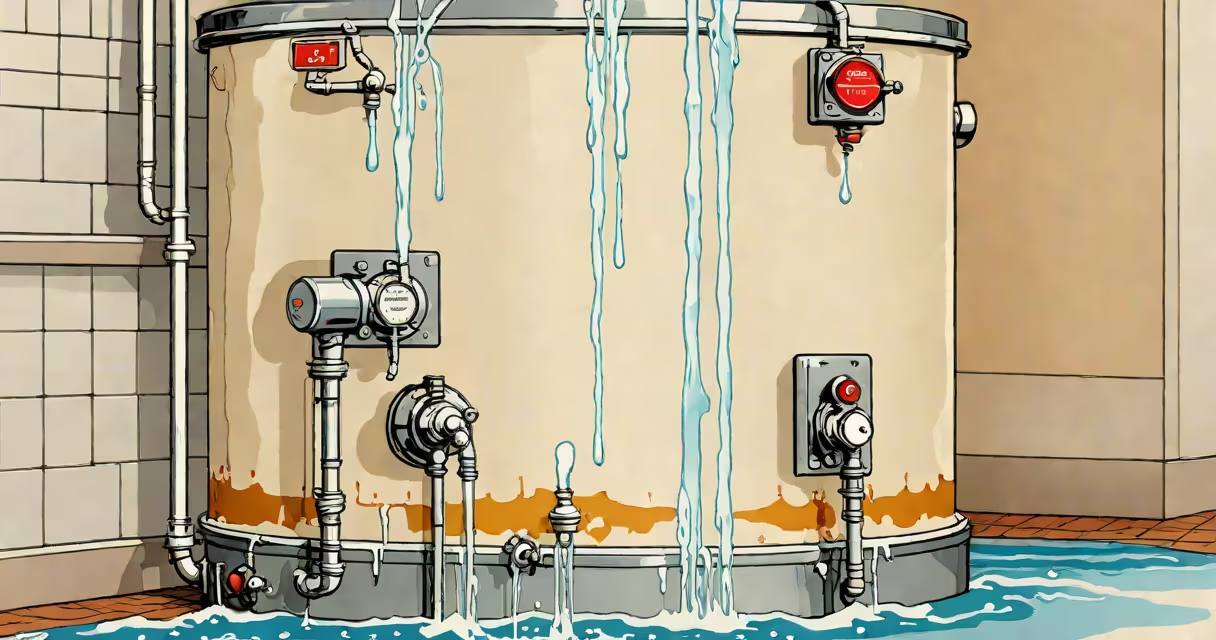
A leaking water heater indicates a loss of containment in the tank or a failure in one of its components, often signaling imminent breakdown or safety risk. The leak may stem from corrosion, loose fittings, or excessive internal pressure. Left unaddressed, it can cause property damage, mold growth, or even a rupture.
Water heaters store and heat water under pressure. When the tank develops micro-cracks or the anode rod depletes, water escapes through seams or drain valves. A small drip may seem minor, but it often precedes a full collapse. According to the American Society of Heating, Refrigerating, and Air-Conditioning Engineers (ASHRAE), 60% of residential water heater failures involve visible leakage prior to complete failure.
Water heaters operate by heating water inside a sealed steel tank. As water heats, it expands. Pressure relief valves release excess pressure to prevent explosion. If the valve fails or the tank corrodes, water escapes through weak points. Most leaks originate from the drain valve, temperature and pressure (T&P) relief valve, or the tank itself.
When the anode rod-the sacrificial metal that protects the tank from rust-wears down completely, internal corrosion accelerates. Once the steel lining begins to degrade, the tank loses integrity. Even a 1/8-inch hole can release 10 gallons per hour under 60 psi pressure. That's enough to flood a basement in under two hours.
Leak detection systems exist in newer models. These sensors detect moisture and shut off power and gas supply automatically. They don't stop the leak, but they reduce fire and electrocution risks during emergencies.
Not all leaks come from the same place. Identifying the source determines whether a fix is possible or replacement is required.
| Leak Location | Most Likely Cause | Repairable? | Typical Lifespan Before Failure |
|---|---|---|---|
| Drain valve | Worn washer or improper installation | Yes, replace washer or valve | 1-3 years with regular maintenance |
| T&P relief valve | Overheating or sediment buildup | Yes, test and replace if needed | 5-8 years with annual flushing |
| Tank base or sides | Internal corrosion or age-related wear | No, tank must be replaced | Less than 1 year after visible rust appears |
| Connections (inlets/outlets) | Loose fittings or degraded seals | Yes, tighten or replace gaskets | 2-5 years depending on water quality |
For example, a homeowner in Portland, Oregon, reported a steady drip from the T&P valve. After testing, the valve released pressure at 120 psi instead of the rated 150 psi. Replacing the valve restored safe operation. This case shows that early intervention prevents larger failures.
Leaks most commonly appear in basements, utility closets, or garages where water heaters are installed. They're typically located near the bottom of the tank, where sediment accumulates and accelerates corrosion. Hard water increases mineral deposits, which insulate the heating element and raise temperatures-leading to stress on the tank.
According to the U.S. Department of Energy, sediment buildup reduces efficiency by up to 30% and increases failure risk. Flushing the tank annually removes debris and extends lifespan. A 2022 study by the National Association of Home Inspectors found that 44% of inspected water heaters had visible leaks due to neglected flushing.
Non-obvious fact: A leak from the T&P valve doesn't always mean the valve is broken. It can activate when the water exceeds 210°F. If your thermostat is set too high, the valve releases to prevent overheating. Lowering the setting to 120°F reduces strain and prevents unnecessary activation.
Many assume a small drip is harmless. In reality, it's a warning sign. A leak of just 1 ounce per minute equals 144 gallons per month-enough to damage flooring, drywall, and electrical systems.
Another error: attempting to tighten a leaking drain valve with a wrench. Over-tightening cracks the plastic or brass body, worsening the leak. Always turn off power and water supply first. Use a wrench only to snug the valve, not force it.
Some confuse a leaking water heater with a dripping faucet. The source differs: faucets leak from worn cartridges; water heaters leak from structural or pressure issues. If water pools around the base of the unit, it's likely the tank or connections-not plumbing fixtures.
Upon discovering a leak, shut off the cold water supply and disconnect power (electric) or gas (gas-powered). Do not attempt to operate the heater until repairs are confirmed.
I once encountered a case in a suburban Chicago home where a tenant ignored a slow drip for six months. The leak worsened during winter, causing 1,200 gallons of water to seep into the basement. The resulting mold remediation cost $8,500. The water heater was 14 years old-well beyond its expected 10-15 year service life.
If the leak is from the drain valve or T&P valve, replacement is straightforward. For tank leaks, replacement is necessary. Most manufacturers recommend replacing units older than 10 years, regardless of condition.
After addressing the immediate issue, schedule a professional inspection. A licensed plumber can test pressure levels, check for sediment, and verify proper venting. Regular maintenance prevents 70% of common failures, according to ASHRAE.
Understanding what a leaking water heater means prevents costly damage. It's not just about stopping water-it's about preventing system-wide failure. Recognizing the signs early saves time, money, and safety risks.
When a water heater leaks, it's not a minor inconvenience. It's a mechanical failure in progress. Address it promptly, identify the source, and act before the situation escalates. A leaking water heater means action is required-before the next drop becomes a flood.