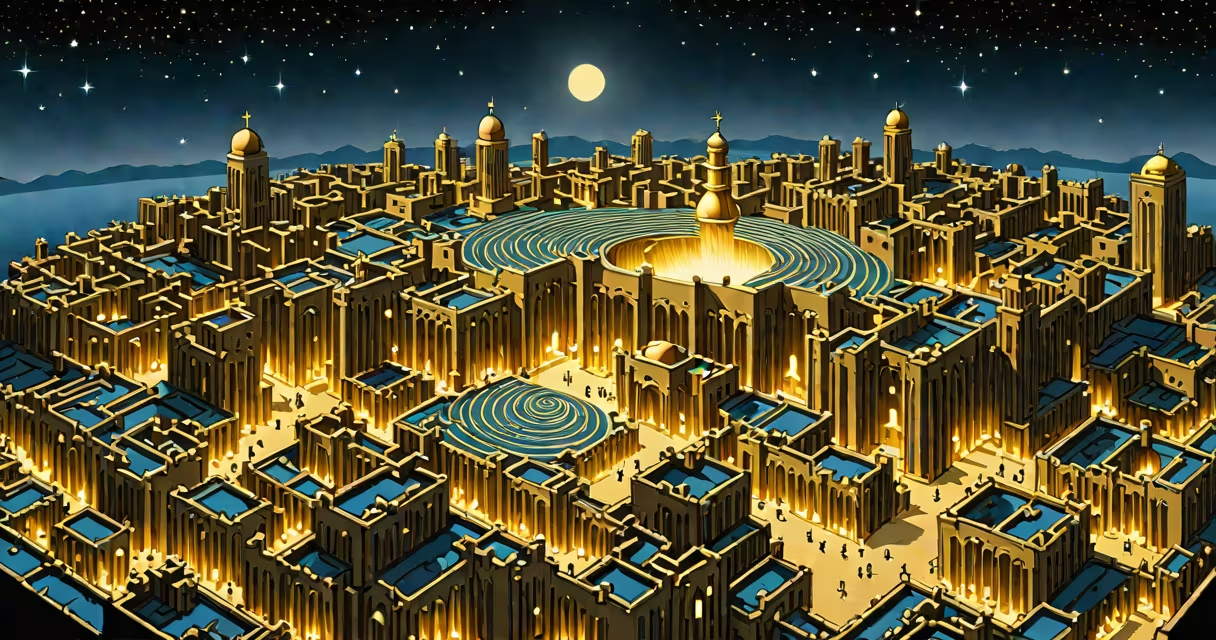
Heaven in the Bible is depicted as a holy, eternal dwelling place prepared by God, featuring a new creation with golden streets, foundations of precious stones, and a city called the New Jerusalem. It is not a vague spiritual area but a tangible, restored reality where God dwells with His people.
The most detailed biblical description of heaven appears in Revelation 21:1-22:5, written by the apostle John during exile on Patmos. This vision reveals heaven not as a distant abstraction but as a transformed cosmos-a renewed earth joined with divine presence. The city's dimensions are precise: 12,000 stadia (about 1,400 miles) long, wide, and high, forming a perfect cube. Its walls are 144 cubits thick (about 65 feet), made of jasper, and its gates are twelve in number, each made of a single pearl.
Revelation 21:18 states the city's wall is "made of jasper," a stone associated with clarity and purity in ancient Near Eastern symbolism. The foundations of the wall are adorned with twelve kinds of precious stones-sardonyx, sardius, chrysolite, emerald, sapphire, lapis lazuli, agate, amethyst, beryl, topaz, chrysoprase, and jacinth-each representing a tribe of Israel. These materials reflect both divine craftsmanship and covenant continuity. The city's streets are made of pure gold, transparent like glass, symbolizing purity and unbroken access to God's presence.
| Feature | Biblical Reference | Symbolic Meaning |
|---|---|---|
| Golden streets | Revelation 21:21 | Purity, divine glory, eternal stability |
| Gates of pearl | Revelation 21:21 | Access granted through Christ; beauty and costliness |
| Foundations of precious stones | Revelation 21:19-20 | Covenant identity; tribal representation; divine value |
| No temple | Revelation 21:22 | God and the Lamb are the temple-direct presence replaces ritual |
Heaven is not merely a passive destination but an active space of worship and relationship. Revelation 22:3 describes no curse remaining-sin and suffering are permanently removed. The tree of life grows on both sides of the river of life, bearing fruit monthly. Its leaves are for healing nations, indicating restoration not just of individuals but of creation itself.
Contrary to popular cultural images of floating clouds and harps, the Bible presents heaven as a physical, ordered, and communal reality. It is not a place of escape from the material world but its fulfillment. Jesus said, "I go to prepare a place for you" (John 14:2)-not to a metaphysical area, but to a location He is building. The Greek word *tò kathistēmi* (to prepare) implies a deliberate act of construction, not just a promise.
A common misunderstanding is equating heaven with a disembodied spirit state. But Paul writes in Romans 8:23 that believers await "the redemption of our bodies." Heaven includes resurrected, glorified physical forms-Jesus appeared with flesh and bones after resurrection (Luke 24:39). The New Jerusalem is not a ghostly dream but a city with measurable dimensions, light, and purpose.
Another misconception is that heaven is a reward based on merit. The Bible consistently frames heaven as a gift of grace. Ephesians 2:8-9 says salvation is "by grace through faith... not by works." The New Jerusalem is not earned-it is given. The gates remain open because God's invitation is perpetual. Revelation 22:17 says, "The Spirit and the bride say, 'Come!'"-an open call, not a closed door.
One non-obvious detail often missed: the New Jerusalem descends from heaven, not ascending. Revelation 21:2 says, "I saw the Holy City, the new Jerusalem, coming down out of heaven from God." This reversal of expectation-where heaven comes to earth-signifies God's ultimate intention: to dwell among humanity, not apart from them. The separation between God and creation ends.
For example, in Revelation 21:3, God declares, "Behold, the tabernacle of God is with men." The Greek word *skēnē* means "tent" or "dwelling." This echoes Exodus 25:8, where God says, "Let them make me a sanctuary, that I may dwell among them." The original tabernacle was a portable tent; now, the final dwelling is a permanent city. The process shows a progression-from temporary meeting places to eternal union.
I once stood in the ruins of the ancient Temple in Jerusalem. The stones were worn, the arches broken. Yet in that silence, I remembered Revelation 21:3: "God will dwell with them." The contrast was stark-fragile human structures versus the eternal city descending from God. That moment clarified that heaven is not a replacement for earth but its completion.
Heaven is not a metaphor for peace or comfort. It is a real place with real structure, real light, and real fellowship. The Bible uses architectural language-walls, gates, foundations-not to confuse readers but to ground the promise in something tangible. When Jesus says, "In my Father's house are many rooms" (John 14:2), He speaks of a home with space for all who belong to Him.
Understanding heaven as described in the Bible changes how we live now. If God is preparing a place with gold streets and gates of pearl, then the values of justice, beauty, and holiness matter deeply. The same God who designed the New Jerusalem also created the original Garden of Eden. Both reflect His character: order, beauty, and relational intimacy.
For deeper insight into how righteousness shapes our access to this eternal reality, explore the role of righteous living in biblical eschatology.
Heaven in the Bible is not a vague spiritual idea. It is a city of light, a home built by God, and a place where the redeemed will dwell forever. Its description is rich in symbolism, yet grounded in historical and prophetic narrative. To understand what is heaven described as in the Bible is to grasp the full scope of God's redemptive plan.