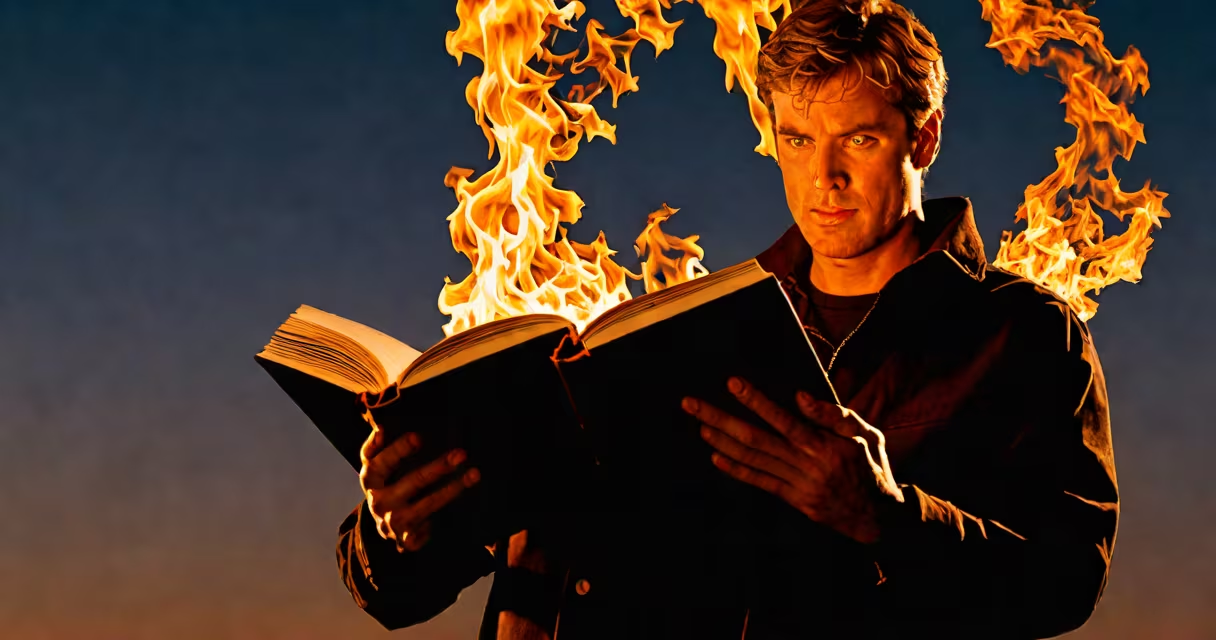
The plot of Fahrenheit 451 follows Guy Montag, a fireman in a future American society where books are outlawed and burned to suppress dissenting ideas. The story unfolds over three parts: discovery, rebellion, and escape.
Montag's job is to burn books, which are illegal because they promote independent thought. He believes his work serves public safety until he meets a young woman named Clarisse McClellan, who asks him if he's happy. Her question unsettles him. Later, he witnesses a woman choosing to die with her books rather than surrender them. This moment triggers his internal crisis.
Montag begins secretly collecting books. His wife, Mildred, is deeply immersed in a wall-sized television screen that plays constant, shallow entertainment. She overdoses on sleeping pills, revealing the emotional emptiness of their world. Montag confides in Faber, a retired English professor, who becomes his mentor. Together, they plan to resist the state's control over knowledge.
The narrative progresses through escalating conflict. Montag's superior, Captain Beatty, delivers a lecture on why books were banned-because they make people uncomfortable with contradictions and differences. Beatty argues that uniformity brings peace, though he himself is well-read and uses literary references to manipulate Montag.
When Montag's home is raided and a book is discovered, he is forced to burn his own house. He kills Beatty in self-defense during a confrontation. Montag then flees the city, pursued by a mechanical hound designed to track and kill dissenters. He escapes into the countryside, where he joins a group of exiles who memorize entire books to preserve them orally.
The climax occurs when the city is destroyed by war. Montag watches the explosion from afar. The survivors, including the exiles, plan to rebuild society based on memory and wisdom. The novel ends with Montag reciting poetry from memory as the group walks toward a new beginning.
Fahrenheit 451 critiques censorship, mass media, and the erosion of critical thinking. Books represent free thought and human complexity. Their destruction symbolizes the suppression of individuality and historical awareness.
Television screens dominate daily life, replacing conversation and introspection. Mildred spends hours in "parlor walls" - large interactive screens that simulate social interaction. When she says, "I'm not a person," she reveals how identity is lost in passive consumption.
Fire is both destructive and redemptive. Montag starts as a tool of destruction, but by the end, he uses fire to purify and protect knowledge. The title refers to the temperature at which paper ignites-451°F-but also symbolizes the point at which society becomes unsustainable due to ignorance.
Resistance appears in different forms. Clarisse represents curiosity and moral questioning. She is killed early, suggesting that open inquiry is dangerous in this world. Faber embodies intellectual resistance-he knows the value of books but fears action.
Montag undergoes transformation. His turning point is not a single event but a series of small awakenings: the woman's suicide, his wife's overdose, and his growing unease with his role.
The exiles represent cultural preservation. They do not destroy knowledge-they memorize it. This method mirrors oral traditions in ancient societies, such as those in Greece or India, where epics were passed down by memory before being written.
| Form of Resistance | Character Example | Method | Outcome |
|---|---|---|---|
| Curiosity | Clarisse McClellan | Asking questions about happiness and nature | Eliminated by the state |
| Knowledge | Faber | Providing insight and tools for change | Escapes to join the exiles |
| Memory | Group of exiles | Memoirizing entire books | Survives the war and plans reconstruction |
Many assume Fahrenheit 451 is solely about book burning. It is not. The core issue is not censorship of texts-it is the loss of attention, empathy, and meaningful dialogue. The government doesn't ban books because they're dangerous. It bans them because they challenge comfort and convenience.
Another error is thinking Montag acts alone. He is supported by Faber and later by the exiles. His process is not heroic in isolation-it is collective. The novel ends not with a single savior, but with a community rebuilding through shared memory.
A lesser-known fact: Bradbury wrote the novel in 1953, during the McCarthy era. He was alarmed by the rise of anti-intellectualism and fear-based politics. The book reflects concerns about how propaganda and distraction can erode democracy-even without overt violence.
In 2022, the American Library Association reported 1,261 book challenges in U.S. schools and libraries. Titles like *The Bluest Eye* and *Gender Queer* were targeted. These efforts mirror the logic in Fahrenheit 451: remove material that disrupts dominant narratives.
Research from the University of Pennsylvania shows that people exposed to diverse viewpoints in adolescence are more likely to engage in civic life. Conversely, those raised in echo chambers show reduced tolerance for disagreement. This supports Bradbury's warning: when exposure to complex ideas is removed, society loses resilience.
I once attended a high school debate where students argued whether Fahrenheit 451 should be taught. A student said, "It's not relevant anymore." I pointed out that the book's central question-"What happens when we stop asking hard questions?"-remains urgent. Today's algorithms prioritize engagement over truth. That's not far from the world Bradbury imagined.
The plot of Fahrenheit 451 is not a warning about firemen or books. It is a warning about silence. The novel shows that when people stop listening to each other, when they replace conversation with noise, and when they accept comfort over truth, society becomes vulnerable to collapse.
Montag's process-from passive enforcer to active learner-mirrors the process of awakening. It requires discomfort, risk, and connection. The story ends not with victory, but with preparation. The exiles don't reclaim power. They wait. They remember. They build.
Understanding the plot of Fahrenheit 451 means recognizing that knowledge is not just information-it is survival. The novel remains essential reading because it asks what kind of world we want to live in. And it demands we answer.