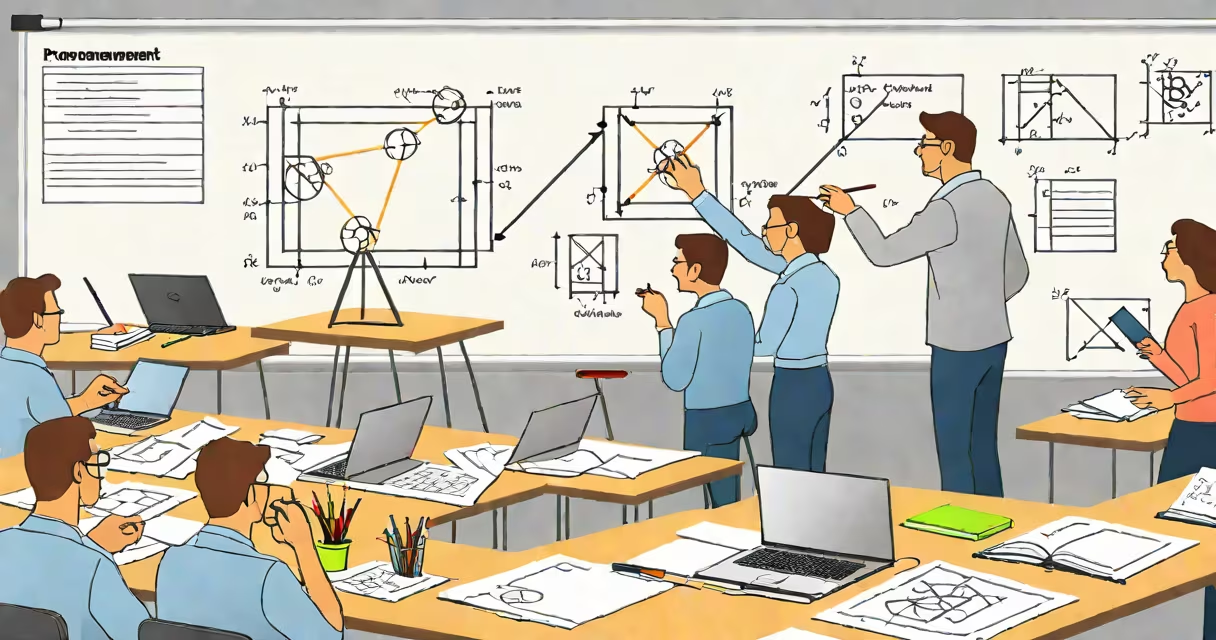
The purpose of formative assessment is to inform instruction while students are still learning. It involves collecting evidence of understanding during a lesson or unit to adjust teaching in real time, ensuring students master concepts before moving forward.
Formative assessment is not about grading. It's about identifying what students know, what they're struggling with, and how to respond. Teachers use quick checks-like exit tickets, think-pair-share, or short quizzes-to gather data and modify their approach within the same lesson or the next day.
According to the National Council of Teachers of Mathematics (NCTM), formative assessment "is embedded in daily instruction" and "supports teachers in making decisions about what to teach next." The goal is not to measure performance after learning ends, but to shape learning as it happens.
Formative assessment functions through cycles of observation, feedback, and adjustment. A teacher poses a question, observes student responses, analyzes misconceptions, then adapts the next step of instruction based on what was learned.
For example, during a math lesson on fractions, a teacher asks students to solve 3/4 × 1/2 using drawings. After five minutes, they scan the room and notice 6 out of 24 students drew rectangles divided into eighths but didn't label the shaded portion correctly. The teacher pauses, re-explains the concept using a different visual model, and gives a follow-up prompt: "Draw this problem using a number line."
This cycle-observe, analyze, respond-is the core mechanism. It prevents students from continuing with misunderstandings that compound over time. Research from Black and Wiliam (1998) shows that formative assessment improves student achievement by an average effect size of 0.79, equivalent to moving a student from the 50th to the 79th percentile.
Formative assessment tools vary in structure and timing. They can be informal, low-stakes, and integrated into regular classroom routines.
| Type | When Used | Example | Best For |
|---|---|---|---|
| Quick checks | During lesson | "Raise your hand if you agree with this solution." | Identifying whole-class misconceptions |
| Exit tickets | End of class | "Write one thing you learned and one question you still have." | Assessing individual understanding |
| Think-pair-share | Mid-lesson | Students discuss a prompt with a partner before sharing with class. | Building confidence and revealing peer explanations |
| Whiteboard responses | Real-time | Students solve problems on personal whiteboards and hold them up. | Immediate feedback and error detection |
These tools differ from summative assessments-like end-of-unit tests-that evaluate learning after instruction ends. Formative assessment happens *during* learning.
Many educators confuse formative assessment with informal questioning or homework checks. But a true formative assessment requires actionable feedback and instructional adaptation.
For example, asking "Does everyone understand?" and getting nods is not formative. It's a guess. True formative assessment requires evidence-written work, spoken reasoning, or visual models-that reveals thinking. A student may nod yes but still misunderstand the concept.
A key distinction: formative assessment is not about the student's score. It's about the teacher's response. If the teacher doesn't change instruction based on results, the assessment wasn't formative-it was just data collection.
I used formative assessment in my 8th-grade science class during a unit on photosynthesis. After a 15-minute inquiry activity, I collected students' lab sheets. One group had written that plants produce oxygen because they "breathe out air." I noticed this pattern across three groups.
Instead of moving to the next activity, I paused. I asked students to draw a diagram of what happens inside a leaf. Then I walked around, spotted the same misconception in four more students, and restructured the next 20 minutes around correcting the idea that plants "breathe" like animals.
By the end of the lesson, 92% of students correctly explained that oxygen is a byproduct of light-dependent reactions. Without formative assessment, I'd have assumed understanding and moved on-leading to persistent errors on the unit test.
Research from the Educational Testing Service (ETS) confirms that effective formative practices reduce achievement gaps. Students from lower-income backgrounds benefit most-up to 20% greater gains in reading and math when formative feedback is consistent and specific.
Formative assessment turns frustration into progress. When teachers see where students are stuck, they don't just assign more work-they adjust. They reteach, reframe, or reengage.
It's not about doing more. It's about doing what matters. The purpose of formative assessment is to make learning visible, timely, and responsive. It ensures no student falls behind unnoticed.
When used consistently, it transforms classrooms from places of passive consumption to changing spaces of growth. The goal isn't perfection-it's progress. And formative assessment is the compass that keeps instruction on track.
begins with seeing where students are-and responding.