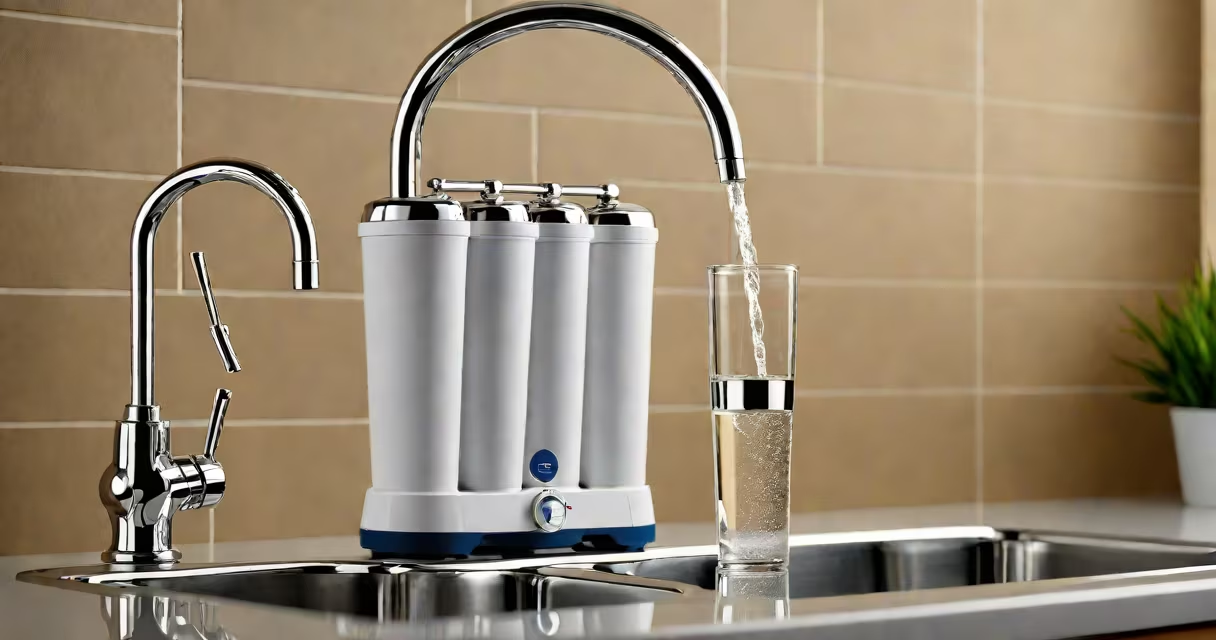
A reverse osmosis water filter removes dissolved contaminants like lead, nitrates, fluoride, arsenic, and chlorine by forcing water through a semi-permeable membrane under pressure. This process reduces total dissolved solids (TDS) to below 10 parts per million, producing water nearly free of impurities.
Reverse osmosis operates by reversing natural osmotic flow. Normally, water moves from low-solute to high-solute environments to balance concentration. In reverse osmosis, external pressure exceeds osmotic pressure, pushing water molecules through the membrane while trapping larger ions and molecules on the input side.
The system typically includes a pre-filter to remove sediment and chlorine, a carbon filter to reduce volatile organic compounds (VOCs), the RO membrane itself, and a post-filter to polish the final output. A storage tank holds filtered water until drawn via a dedicated faucet.
When tap water enters the system, it first passes through a 5-micron sediment filter. This removes rust, sand, and silt particles that could clog the membrane. Next, a granular activated carbon (GAC) filter absorbs chlorine and chloramines, which degrade the membrane's integrity over time.
After pre-filtration, pressurized water reaches the RO membrane-a thin-film composite (TFC) layer with pores sized at 0.0001 microns. Only water molecules small enough to pass through-about 1 in 100,000-make it through. Dissolved salts, heavy metals, pesticides, and pharmaceutical residues remain behind.
Waste water containing trapped contaminants flows out through a drain line. The purified water then goes through a post-carbon filter to eliminate any remaining taste or odor before exiting through the dedicated faucet. A typical system processes 1 gallon of purified water for every 3 gallons of feedwater, with the rest going to waste.
Reverse osmosis systems come in different configurations based on installation and capacity:
| System Type | Flow Rate | Use Case | Installation |
|---|---|---|---|
| Under-sink | 15-30 gallons/day | Single-family homes, standard kitchen use | Mounted beneath sink; connects to cold water line |
| Countertop | 10-20 gallons/day | Apartment living, temporary setups | Plugs into existing faucet; no plumbing required |
| Whole-house | 100-500 gallons/day | Large homes, well water with high TDS | Installed at main water line; serves entire home |
Under-sink models dominate residential use due to space efficiency and higher flow rates. Countertop units offer portability but require frequent emptying of the storage tank. Whole-house systems are rare due to cost and maintenance demands but essential in areas with high mineral content or contaminated groundwater.
Many assume reverse osmosis removes all minerals-including beneficial ones like calcium and magnesium. While it does strip dissolved minerals, the human body obtains most essential minerals from food, not water. The National Sanitation Foundation (NSF) confirms that RO-treated water poses no nutritional risk when consumed as part of a balanced diet.
Another misconception is that RO filters make water "dead" or harmful. This claim lacks scientific basis. RO water is biologically inert but safe. It's comparable to distilled water in purity, though RO retains trace levels of beneficial ions depending on source water composition.
Some users report a flat taste. This occurs because RO removes everything-minerals, chlorine, and even subtle flavor compounds. Adding a remineralization cartridge restores balance. For example, a study published in Environmental Science & Technology found that remineralized RO water scored higher in palatability tests than untreated RO water.
In 2016, residents of Flint faced elevated lead levels in municipal water. A family installed a 5-stage under-sink RO system with a post-filter containing calcium carbonate and magnesium oxide. After six months, lab testing showed lead levels dropped from 12 ppb (above EPA action level of 15 ppb) to undetectable (<0.5 ppb).
They reported improved taste and reduced staining on fixtures. The system processed 20 gallons daily, meeting household needs. Maintenance included replacing the pre-filter every 6 months and the RO membrane annually-costing $120/year in parts.
For context, the Environmental Protection Agency (EPA) states that reverse osmosis effectively removes 99% of lead, arsenic, and fluoride when properly maintained. The NSF/ANSI Standard 58 certifies systems that meet these performance thresholds.
Reverse osmosis is often mistaken for carbon filtration. Carbon filters adsorb chlorine, VOCs, and some pesticides but don't remove dissolved salts or heavy metals. An RO system outperforms carbon filters in contaminant reduction but requires more maintenance and generates wastewater.
RO is also not the same as distillation. Both produce pure water, but distillation uses boiling and condensation, consuming more energy. RO operates at ambient temperature and pressure, making it more practical for home use.
Finally, RO is not a substitute for municipal treatment. It supplements existing infrastructure. In cities with clean water supplies, RO may be unnecessary unless specific contaminants are known. Testing your local water report via EPA's Safe Drinking Water Act database helps determine need.
I installed a reverse osmosis system in my own kitchen after testing my tap water and finding nitrate levels above the recommended limit. Within days, the difference in taste was noticeable. My coffee tasted cleaner, and my kettle developed less scale. The system runs quietly and fits neatly under the sink.
Understanding what a reverse osmosis water filter does reveals its role as a precision tool-not a universal fix. It excels where other methods fail: removing invisible, harmful substances that threaten long-term health. When paired with proper maintenance and source water analysis, it delivers water that meets or exceeds clinical standards.