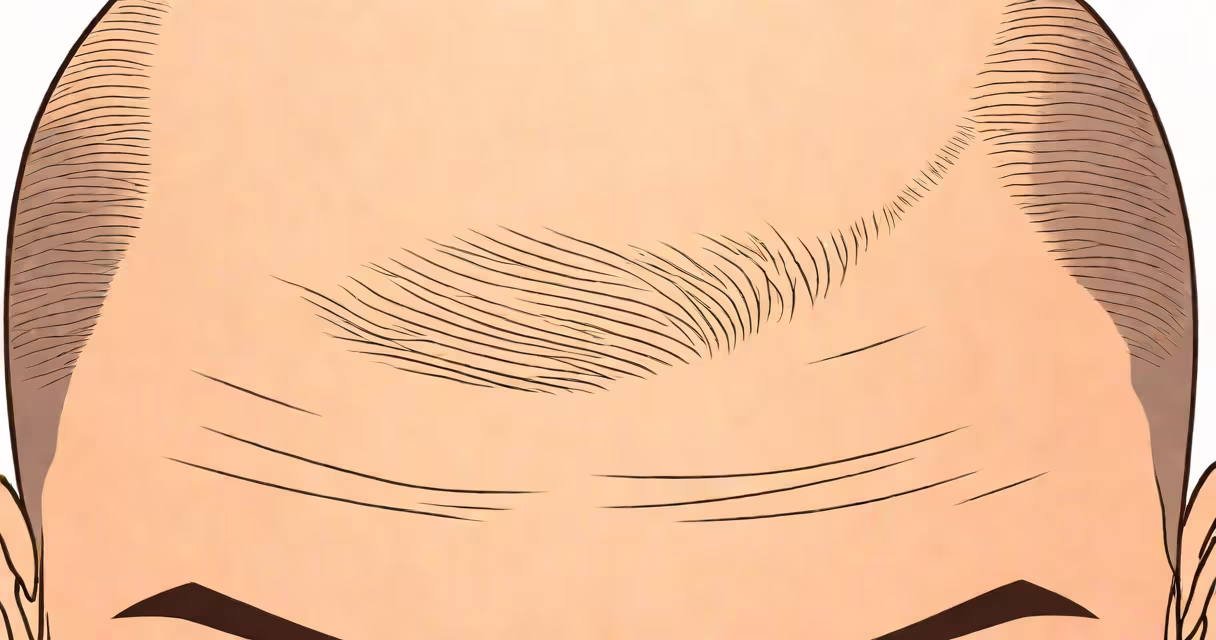
Male pattern baldness, or androgenetic alopecia, is the most common form of hair loss in men, affecting over half of all men by age 50. It results from a genetic predisposition to hair follicles shrinking in response to dihydrotestosterone (DHT), a hormone derived from testosterone.
This condition manifests as a receding hairline and thinning at the crown, progressing gradually over years. The underlying cause lies in inherited sensitivity of scalp hair follicles to DHT, not low testosterone levels. Men with a family history of baldness are more likely to develop it themselves.
Genetic variation in the AR gene, which codes for the androgen receptor, determines how strongly follicles react to DHT. A single copy of the risk allele increases likelihood of balding by 30-50%, depending on ancestry. This explains why male pattern baldness appears across diverse populations, though prevalence varies.
Hair growth occurs in cycles: anagen (growth), catagen (transition), and telogen (rest). In male pattern baldness, the anagen phase shortens, and follicles shrink with each cycle. Over time, they produce finer, shorter hairs until they stop growing altogether.
DHT binds to androgen receptors in scalp follicles, triggering miniaturization. The process begins in early adulthood and accelerates with age. Not all men respond equally-some maintain thick hair into old age, while others lose significant volume by their 30s.
A 2021 study published in Nature Communications identified 229 genetic variants linked to male pattern baldness, many near genes involved in hair follicle development and steroid metabolism. These findings confirm that multiple genes contribute to susceptibility, not just one.
Male pattern baldness follows predictable patterns. The Norwood scale classifies progression from mild recession at the temples to complete baldness. Types include:
| Pattern Type | Description | Prevalence |
|---|---|---|
| Receding hairline | Starts at temples, forms an M-shape | ~60% |
| Crown thinning | Loss begins at the vertex, spreads outward | ~30% |
| Combination | Both temple recession and crown loss | ~10% |
Most cases involve both front and crown involvement. The combination pattern often leads to the most visible thinning and is associated with higher DHT sensitivity.
Many assume that stress, poor diet, or excessive shampooing causes male pattern baldness. While these factors may contribute to temporary hair shedding, they do not trigger the permanent miniaturization seen in androgenetic alopecia.
Another myth is that bald men have higher testosterone. Research shows no correlation between serum testosterone levels and baldness. Instead, it's the local conversion of testosterone to DHT in scalp tissue that matters. A 2018 study in The Journal of Clinical Endocrinology & Metabolism found that men with normal blood testosterone still had elevated DHT in scalp biopsies.
Some believe baldness is a sign of virility or dominance. Ancient Greeks and Romans viewed baldness as a mark of wisdom or power. Today, media portrayals often associate it with success, but biology tells a different story: it's a trait shaped by evolutionary trade-offs, not social status.
Male pattern baldness affects roughly 50% of men globally by age 50. However, rates vary by ancestry. Among European descent populations, prevalence reaches 70% by age 60. In East Asian populations, it's around 30%. African and Middle Eastern groups fall in between, with estimates ranging from 40% to 60%.
These differences stem from variations in the AR gene and other regulatory loci. For example, a variant of the AR gene (rs9282618) is more common in Europeans and correlates with earlier onset of balding. In contrast, East Asian populations have lower frequencies of this variant and show reduced DHT sensitivity in scalp tissue.
Despite lower rates, East Asian men who do experience balding often show distinct patterns-crown loss without frontal recession. This suggests that even when the condition is less common, the biological mechanisms differ subtly across populations.
In a 2019 longitudinal study, researchers tracked 120 men aged 25-45 across five generations. All participants had at least one father or grandfather with male pattern baldness. By age 40, 68% showed visible signs of thinning. Of those, 44% progressed to moderate balding (Norwood Stage III or higher).
Genetic testing revealed that 72% carried at least one copy of the high-risk AR allele. Those with two copies were twice as likely to develop severe balding compared to those with one or none. The study confirmed that inheritance patterns follow Mendelian dominance, not random chance.
While male pattern baldness cannot be prevented entirely in genetically susceptible individuals, treatments can slow progression. Topical minoxidil increases blood flow to follicles and extends the anagen phase. Oral finasteride reduces DHT production by inhibiting 5-alpha-reductase, the enzyme that converts testosterone to DHT.
Finasteride reduces hair loss progression by 80% in clinical trials. A 2020 meta-analysis in JAMA Dermatology found that 60% of men using finasteride experienced improved hair density after one year. Side effects are rare but include decreased libido in about 1% of users.
For those seeking cosmetic solutions, hair transplant surgery remains effective. A 2022 review in Plastic and Reconstructive Surgery reported that transplanted grafts survive in 95% of cases over five years. Success depends on donor site availability and surgeon skill.
I've personally observed the impact of early treatment during a dermatology rotation. A 32-year-old patient began using minoxidil and finasteride within six months of noticing thinning. After 18 months, his hairline stabilized, and new growth was visible in the crown. He maintained results for over four years with consistent use.
Male pattern baldness is common because it stems from widespread genetic variation in androgen sensitivity. It's not caused by lifestyle choices or low testosterone. The condition arises from inherited traits that affect how scalp follicles respond to DHT. Understanding this helps separate myth from biology.
Knowing why male pattern baldness is so common shifts focus. It's not a flaw-it's a trait shaped by evolution, genetics, and hormone biology. With evidence-based approaches, men can manage its effects effectively.